 공지사항
Love wins again – landmark Supreme Court ruling recognizes dependent status for same-sex partner in health insurance in Korea
Love has won again.
On 18 July 2024, the Supreme Court of Korea (full bench, Presiding Justice Kim Seon-su) upheld the lower court’s ruling in favor of the plaintiff, affirming that the National Health Insurance Service’s refusal to recognize same-sex partners as dependents constitutes a grave violation of fundamental rights (Supreme Court Decision 2023Du36800, full bench, rendered 18 July 2024).
The Supreme Court maintained the view of the appellate court that the administrative act of imposing insurance premiums on the plaintiff, Mr. So Seong-wook, the same-sex partner of the workplace subscriber Mr. Kim Yong-min, by denying his dependent status, was not only procedurally unlawful but also substantively unlawful for violating the constitutional principle of equality. The Court went further to emphasize the need for public systems to actively respond to changing family structures, based on the recognition and respect for same-sex partner partnerships.
The Court pointed out that, when judged according to the intent and purpose of the National Health Insurance system as a social security system, dependent status has evolved over time, taking into account changing family compositions. In the case of ‘same-sex partners’ like the plaintiff, although they cannot legally register a marriage, they form an economic partnership comparable to married life, going beyond mere cohabitation.
Ultimately, the Court held that discriminating against partners who meet the same conditions under the same system and whose applications align with the system’s protective purpose solely based on the distinction between ‘opposite-sex partners’ and ‘same-sex partners’ constitutes discrimination based on sexual orientation. This constitutes discrimination that infringes upon human dignity and value, the right to pursue happiness, freedom of private life, and the right to equality before the law.
The argument we consistently made since the first instance was fully accepted. The Court further stated that the dependent support system, as a fundamental social security system, requires “actively responding to the changing forms of family bonds today to resolve inequality.” It was a complete victory for the plaintiff. The supplementary opinion to the majority opinion further conveyed the message that society and the state must not exclude same-sex partners, recognizing their existence as a new form of familial community.
Even now, most of our society has not withdrawn its prejudiced and discriminatory gaze toward same-sex unions. In this context, when two people accept their sexual orientation, pledge to share their lives as same-sex partners, and publicly declare this commitment—even while enduring prejudice and discrimination—it represents a profound deliberation and resolution: an affirmation of their own existence and a vow to fulfill their obligations of affection, cohabitation, support, cooperation, and fidelity to their same-sex partner as promised. This is their existential decision grounded in human dignity.
For an individual, as a member of society, to be formally excluded from the protection of the health insurance system—the most fundamental social safety net operated by the state—solely because their partner relationship is formed between individuals of the same sex, can be perceived by the parties involved as a denial of their inherent value as beings deserving of society’s and the state’s recognized protection. It can constitute an intolerable and grave infringement upon the right to form one’s own personality, establish a familial community, and live within it according to one’s own gender identity and sexual orientation.
(Excerpt from the supplementary opinion to the majority opinion)
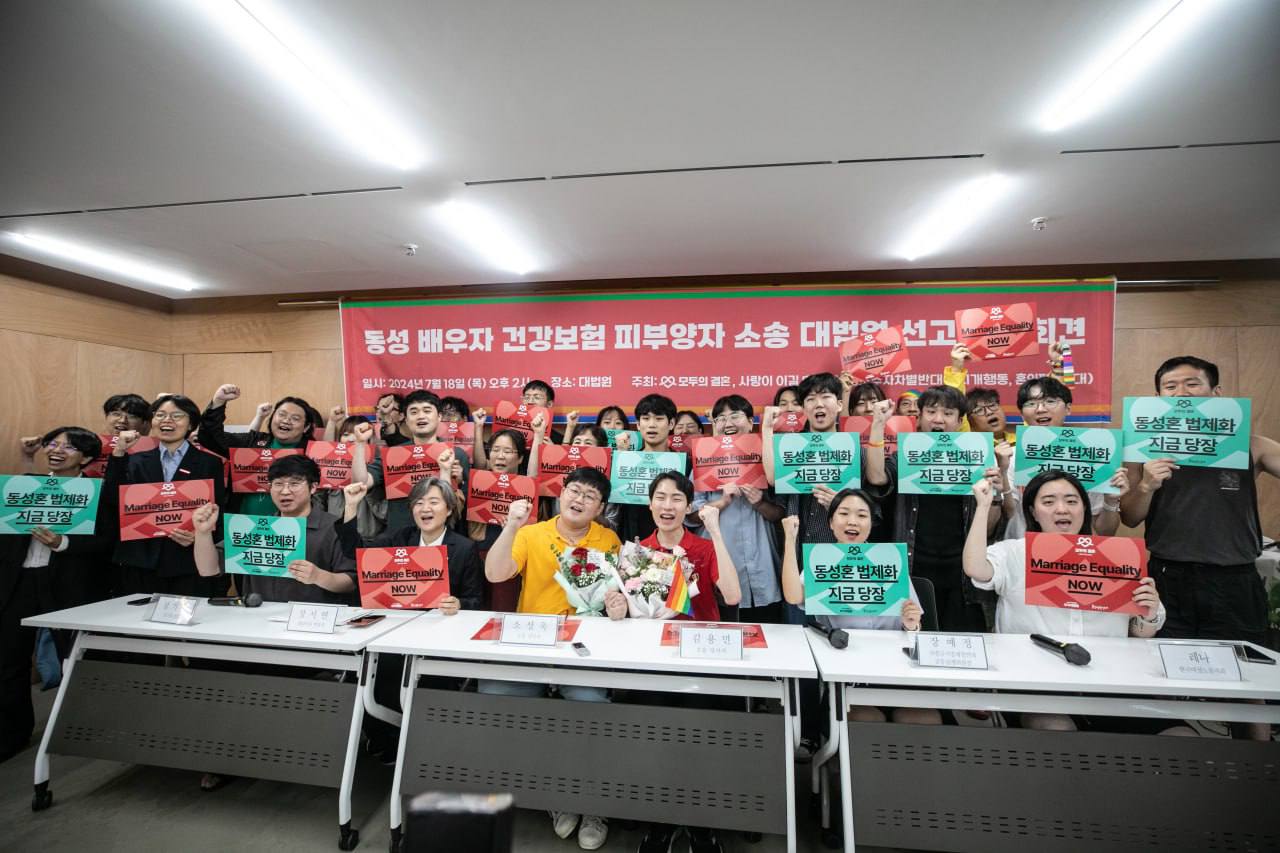
I heard the news of the Supreme Court victory on the last day of my sabbatical. Coincidentally, I was out of town and couldn’t join the celebration. When the appellate court overturned the first instance decision and ruled in our favor, I felt happiness but couldn’t fully smile, knowing the Supreme Court proceedings remained. Hearing the Supreme Court’s decision, I finally thought, “Ah, now I can relax,” and only then did I laugh wholeheartedly. The expressions of the plaintiff couple and their colleagues in the photo also seemed bright, as if they had shed their worries.
The Korean society I encountered upon returning home a few days later appeared outwardly unchanged. Yet I have no doubt this ruling—the first in Korea to acknowledge the very existence of same-sex couples and further establish the duty to protect them within public institutions—will exert powerful influence beyond the courts, driving a shift in our society’s collective consciousness.
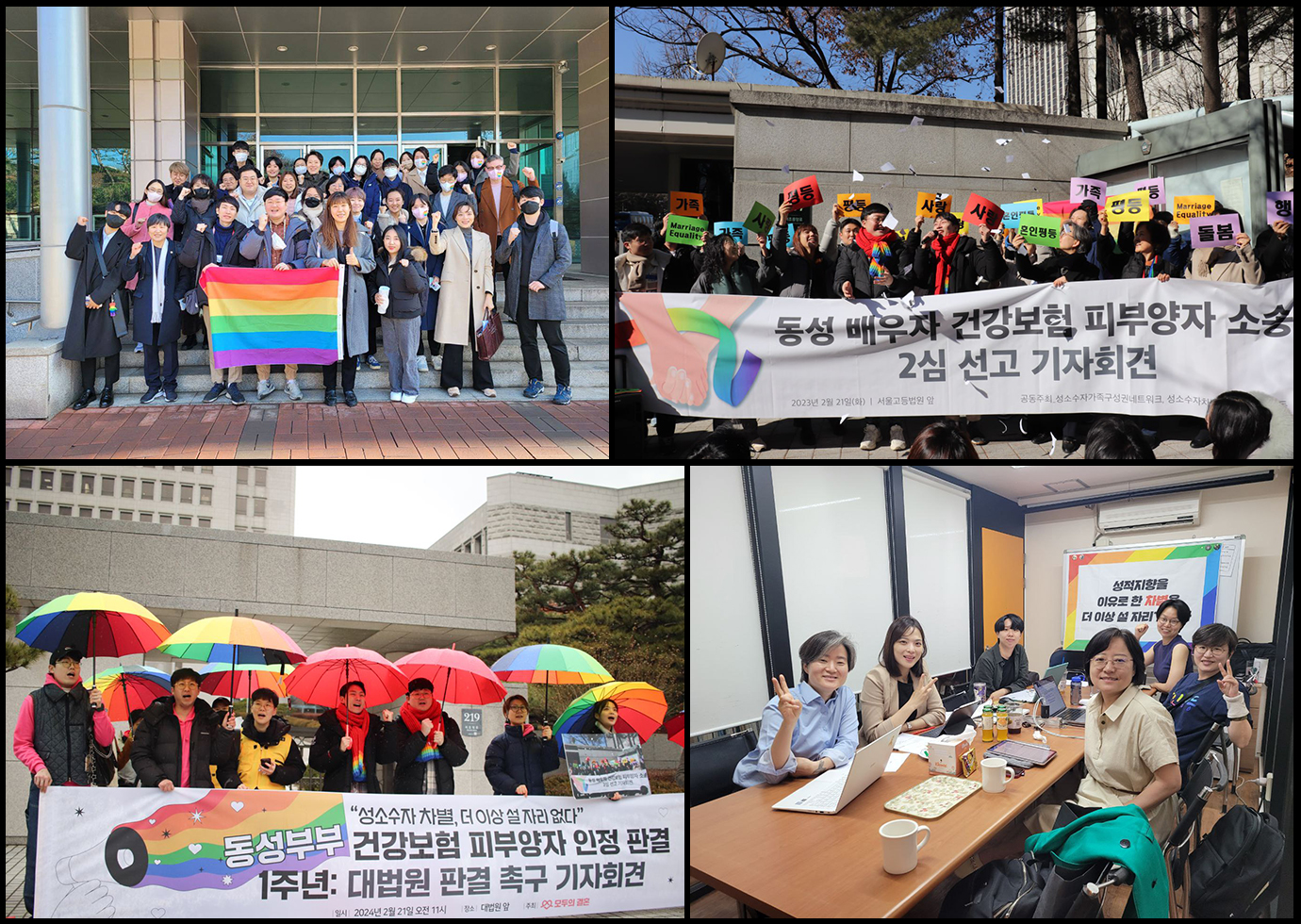
It took a total of eight years, from when the legal team representing the same-sex marriage lawsuit began preparing arguments in 2017—focusing on the specific rights of ‘spouses’ that did not apply to same-sex couples, particularly dependent status for health insurance—until the Supreme Court ruling in 2024. The entire Gonggam LGBTQ+ team was assigned to the case, pouring their heart and soul into this lawsuit. The more I read this ruling, the more I am convinced that the world, though very slowly, is still changing little by little in a better direction, a direction that recognizes diversity. We have many lawsuits we are preparing and many ongoing lawsuits concerning the rights of minorities. I imagine Korean society eight years from now. On this day when that imagination has become reality, we can all rejoice together to our hearts’ content.
Related article: NPR, “South Korea’s top court recognizes some rights for same-sex couples” (18 July 2024)
Written by Jirim Kim