 공지사항
Knocking on the National Assembly’s door again to introduce mandatory human rights and environmental due diligence
On June 13, Representative Jung Tae-ho introduced the “Act on the Protection of Human Rights and the Environment for Sustainable Management of Enterprises” to the National Assembly of the Republic of Korea. This bill, prepared and promoted by KTNC Watch in which Gonggam participates, was reintroduced to the 22nd National Assembly after undergoing revisions and improvements following the previous bill’s expiration due to the end of the 21st National Assembly’s term.
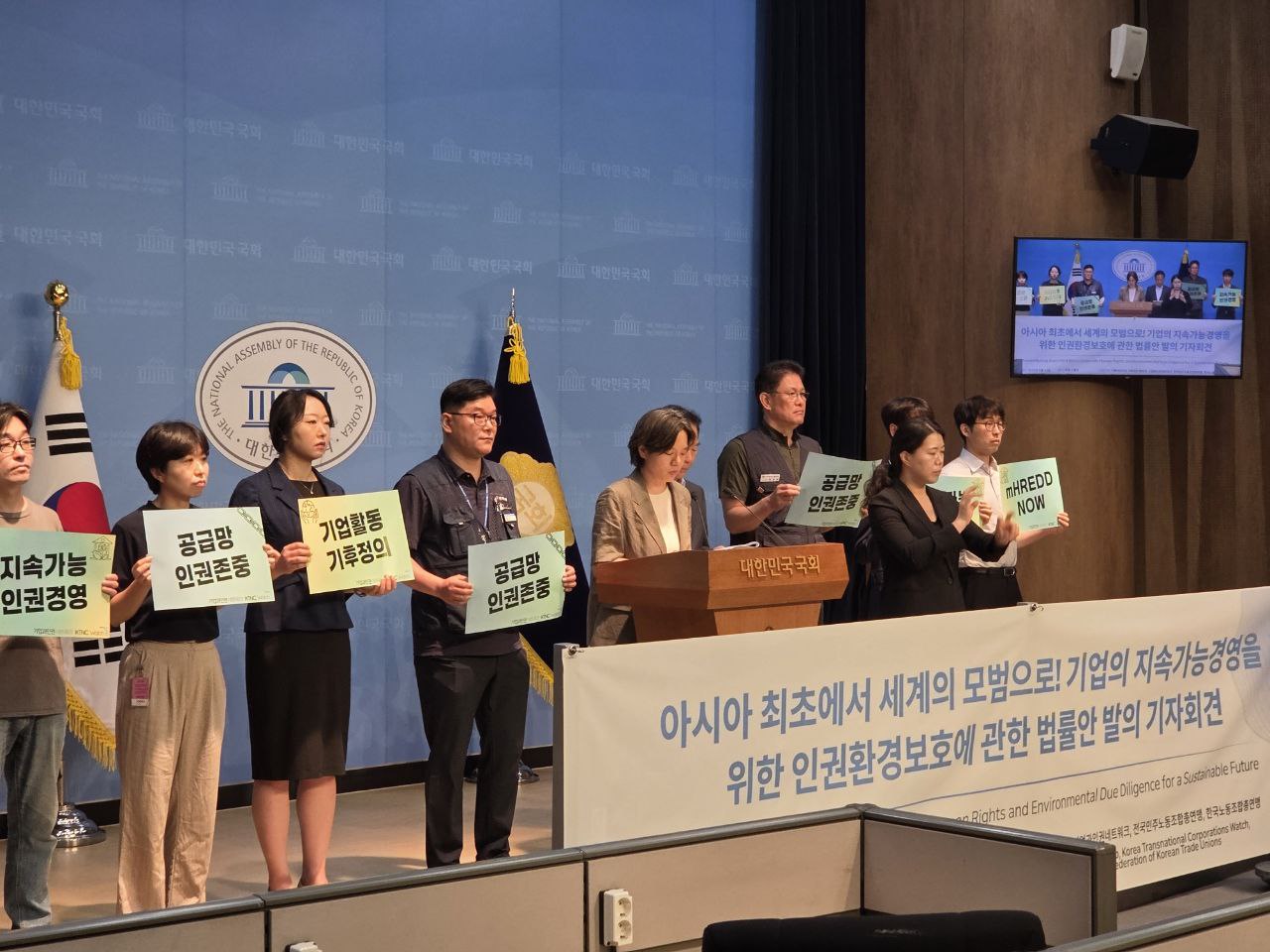
The bill codifies the social and environmental responsibility of multinational corporations, commensurate with their growing influence, as they engage in multifaceted relationships with various stakeholders, including states and individuals. It is grounded in the UN Guiding Principles on Business and Human Rights, which outline how companies should fulfill their responsibility to respect human rights.
To avoid harming human rights and the environment, companies must first assess the impact their activities have on human rights or the environment. Upon identifying potential or actual issues, they must immediately leverage their influence to take measures to prevent, eliminate, or mitigate such impacts. Furthermore, since corporate activities mobilize global supply chains, the impacts stemming from these activities necessitate examining the entire supply chain.
This is the core of “due diligence” as required by the bill. Since the adoption of the UN Guiding Principles on Business and Human Rights, it has become an established norm that companies failing to conduct human rights and environmental due diligence cannot claim to be fulfilling their social responsibilities. However, leaving human rights and environmental due diligence solely to corporate discretion is insufficient. As pointed out in the Korean Bar Association’s ‘2024 Business and Human Rights Report’, while Korean companies make declarative commitments to respect human rights, the establishment of systems to actually implement them, along with detailed human rights due diligence and remedial procedures, remains inadequate. Meanwhile, the state has an obligation under international human rights law to prevent human rights violations arising from domestic and overseas business activities of companies within its jurisdiction. Accordingly, various UN human rights bodies, including the UN Human Rights Committee, have consistently recommended that the Korean government introduce mandatory human rights and environmental due diligence.
The purpose of this proposed legislation is to present concrete, binding rules for human rights and environmental due diligence and to have state agencies supervise their implementation. This aims to prevent whitewashing—such as merely going through the motions or shifting the burden onto subcontractors—and to ensure that companies genuinely fulfilling their responsibility to respect human rights and the environment are not disadvantaged. Simultaneously, it seeks to enable appropriate remedies for those affected human rights and environmental violations caused by corporate activities.
In this regard, it is crucial to emphasize that the communication, information sharing, and participation of stakeholders—such as consumers, citizens, local residents, and workers—who may be affected by human rights or environmental violations caused by corporate activities are vital to this process. Only by ensuring stakeholder participation in the due diligence process can problems arising from corporate activities be identified and addressed.
It is no exaggeration to say that all the goods and services we consume and use in our daily lives—from the clothes we wear, the food on our tables, the mobile phones we hold, to the fuel that heats or cools our homes—are produced through domestic and international value chains operated by companies. Yet, more often than not, we remain unaware of the human rights violations or environmental destruction occurring within these processes, while corporations seem more concerned with profit than with such consequences. Yet it is equally clear that if this situation persists, we will ultimately bear the consequences.
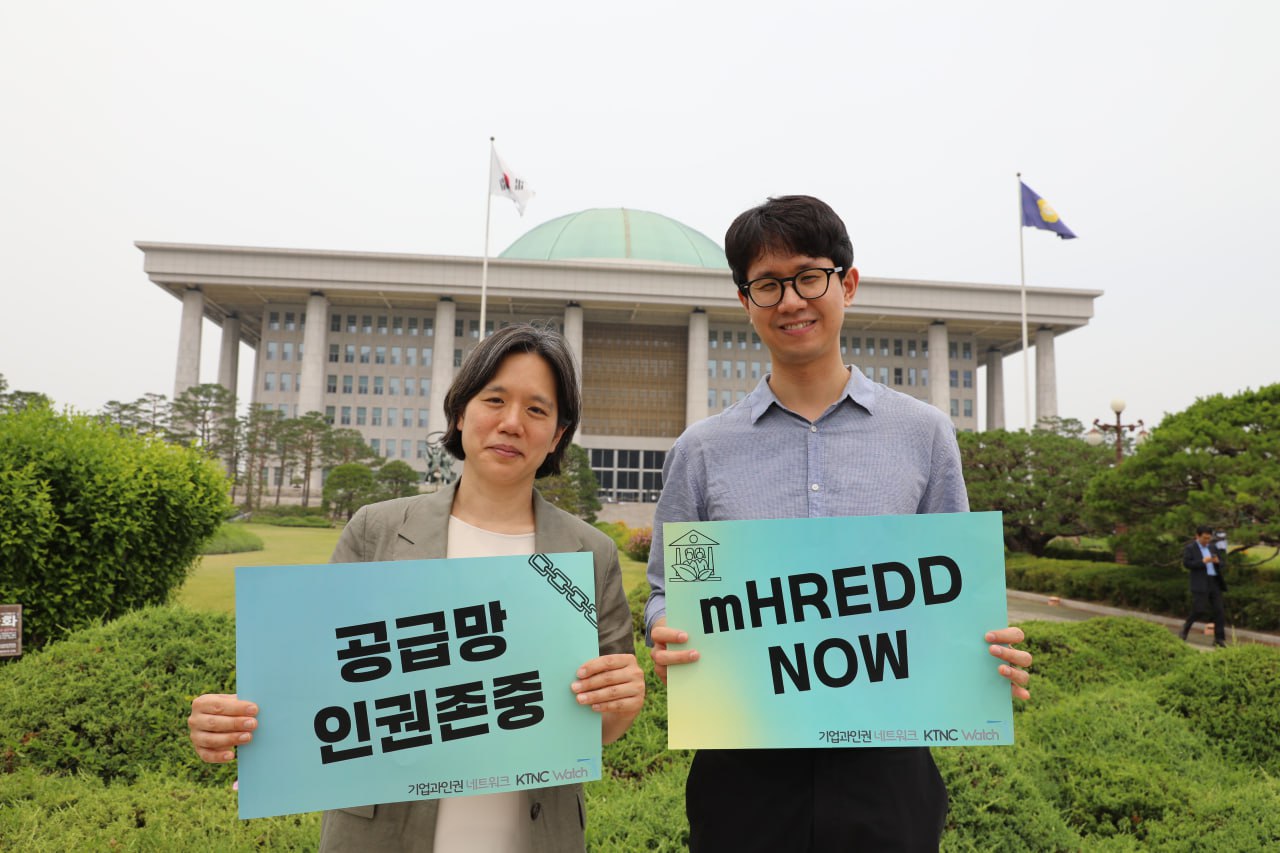
The influence of Korean companies in the global economy is growing. Yet, on the other hand, serious human rights or environmental violations caused by Korean companies are also consistently being raised. For example, serious industrial accidents occur at subcontracted factories producing products for major domestic conglomerates, or Korean companies destroy forests or infringe upon the livelihoods and health of local residents during the extraction of raw materials. Labor exploitation occurs in overseas construction projects awarded to Korean companies, and corporate investments are sometimes used to fund forces threatening a nation’s democracy. Gonggam hopes the bill proposed this time will be passed by the 22nd National Assembly, becoming an important tool to effectively and substantially prevent human rights and environmental violations by corporations.
Written by Youngah Park