 공지사항
Framework Act on Life and Safety Enacted – Significance, Limitations and Future Challenges
On 7 May 2026, the Framework Act on Life and Safety passed the National Assembly plenary session. The Act, which was first proposed in November 2021 but automatically lapsed due to the expiration of the legislative term, was reintroduced in March 2025 and ultimately enacted. This law 1) codifies the rights of disaster victims as stipulated in the special laws regarding the October 29 Itaewon tragedy and the December 29 Jeju Air passenger plane crash at Muan Airport; 2) mandates the establishment of a Life Safety Commission to oversee policies and responses related to safety accidents, such as disasters, and the formulation of a Comprehensive Life Safety Plan to ensure that the rights of victims and those vulnerable to safety risks are guaranteed to the fullest extent possible; 3) introduces a safety impact assessment system for laws, regulations, plans, and projects to pursue a substantive, preventive approach; and 4) codified the establishment of an independent investigative body to ensure the independence and fairness of investigative bodies, which had been the subject of much controversy.
Since the Sewol Ferry disaster in 2014, GongGam has consistently provided legal support to victims of various disasters. Concurrently, we have conducted research on relevant domestic and international laws and practices, advocating for the need for legislative improvements. In particular, we participated in the preparation and operation of “Citizens’ Alliance for the Enactment of the Framework Act on Life and Safety,” a coalition of civil society organizations formed in May 2023. Since September 2024, we have played a leading role in drafting and revising the bill, as well as in discussions and consultations with National Assembly and government officials.
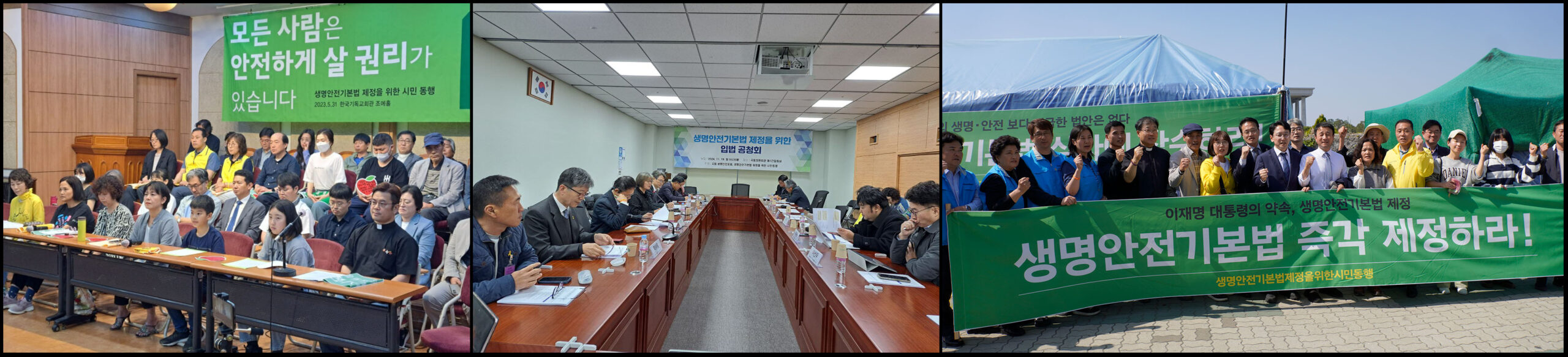
Left) Launch ceremony for the Citizens’ Coalition for the Enactment of the Framework Act on Life and Safety in 2023; Center) Public hearing for the enactment of the Act in 2024; Right) Meetings with officials at the Blue House and others in 2026
The primary significance of the enactment of the Act lies in the fact that, following 12 years of relentless efforts by human rights activists, practitioners, and researchers—and, above all, through the unceasing advocacy of disaster victims—Korean society has now come to recognize, both socially and institutionally, that disasters are human rights issues. This marks a shift from the era before the April 16 Sewol Ferry disaster, when no one viewed disasters as human rights issues. That the starting point and ultimate goal of disaster response is to ensure the rights of victims is no longer merely a declaration.
Second, its significance lies in the introduction of a dedicated entity (the Life Safety Commission), a plan (the Comprehensive Life Safety Plan), and systems for prevention (safety impact assessments) and post-incident investigations (an independent investigative body)—all of which enable a paradigm shift from a disaster response focused on physical measures, recovery, and relief to one centered on the rights of victims. Whenever a disaster occurs, there are always claims that opportunities to prevent it were repeatedly missed. The fact that investigations conducted by organizations and processes that were neither independent nor fair have caused immense suffering for victims and significant social losses further underscores the importance of these measures.
Third, to the best of GongGam’s knowledge, the Act is the world’s first law to specifically enumerate and define the rights of disaster victims and to adopt a human rights-based approach in both its spirit and content throughout the entire law. Internationally, the 2004 Indian Ocean tsunami, which claimed hundreds of thousands of lives, served as a catalyst for moving beyond the perspective of viewing disasters solely through the lens of relief and support, and a movement to view them from a human rights perspective gained momentum. At the United Nations level, human rights principles related to humanitarian aid organizations have been established; reports on the human rights of disaster victims have been submitted by human rights bodies; and discussions on drafting treaties that include the rights of disaster victims—albeit in abstract terms—have continued. Korea’s Framework Act on Life and Safety is expected to make a meaningful and positive contribution to this international trend.
Of course, we inevitably encountered many limitations and challenges during the process of finalizing the bill. The most significant issue was the lack of understanding and commitment on the part of some members of the National Assembly and government officials. Rather than fully understanding the significance, urgency, and practical implications of this law—and working together to flesh out the necessary details—there was a tendency to prioritize political repercussions and vested interests. Some even viewed it merely as an excessive burden of additional work. Consequently, the final bill that passed was inevitably a significant step backward from the original proposal, and a substantial portion of its key provisions was delegated to presidential decrees.
Ultimately, the task remains of how to prepare for and operate each of the systems outlined in the Act, and how to flesh out the key provisions delegated to presidential decrees from a human rights-based and victim-centered perspective. The Citizens’ Coalition for the Enactment of for the Enactment of the Framework Act on Life and Safety, which secured the bill’s passage in the National Assembly’s plenary session, must continue to make substantive contributions throughout the remaining process with even greater strength and substance. The Life Safety Commission, which will be established via a separate presidential decree prior to the law’s implementation, must be led by the President as its chairperson to successfully blaze a trail on this uncharted path. This is because the successful enforcement of the Act is a matter of utmost urgency: it determines whether even one more life is saved or left to perish.
Written by Pillkyu Hwang